In the News

Environmental Rights in Cultural Context – Perspectives from Law and Anthropology

Tuesday, March 22, 2022
2:00pm – 3:30pm
Hybrid Event
In Person:
This event will be held in-person with the option to join by WebEx. The Colloquium will be hosted in the Heritage Room of Homer Babbidge Library, HBL 4-214.

By WebEx:
Use the following link to join the meeting room at 2:00pm: http://s.uconn.edu/hbl4420webex
There is no password necessary to join; simply click ‘Join Meeting‘ on the page to be connected.

Environmental rights, such as the right to a healthy or clean environment, are experiencing increasing recognition within domestic constitutions as well as international human rights instruments and institutions. In parallel, more ecocentric approaches promote so-called rights of nature. Using methods of law and anthropology, this talk will assess to what extent such rights respond to environmental stress of local communities exposed, for instance, to large scale mining, hydro dams or climate change.

Dirk Hanschel studied law at the Universities of Marburg and Heidelberg, Germany, as well as the London School of Economics (LSE), before taking his doctoral/post-doctoral degrees at the University of Mannheim, Germany. He furthermore holds a Master of Comparative Law (Mannheim/Adelaide). After working as a reader at the University of Aberdeen for around two years, he became a professor of German, European and International Public Law at the University of Halle, Germany, in 2015. His research focuses inter alia on topics of environmental law and human rights, topics of comparative constitutional law (such as federalism), the law of international organizations, as well as law and anthropology. In 2019 he became a Fellow at the Max-Planck-Institute for Social Anthropology, Halle, where he conducts an interdisciplinary project on “Environmental Rights in Cultural Context”, together with a group of doctoral and post-doctoral scholars. In autumn 2021 he was appointed Martin Flynn Global Law Professor at UConn Law School.

The Colloquium is sponsored by the Human Rights Institute, the School of Law, and the Connecticut/Baden Württemberg Human Rights Research Consortium.

This event is hybrid. We encourage you to join us in person or to join us by WebEx. It will be recorded.
Tracking Rights Fulfillment in the Human Rights Measurement Initiative

Thursday, February 24, 2022
3:00pm – 4:30pm EST
Virtual Event

About This Event:

In this month’s workshop, we feature the Human Rights Measurement Initiative (HRMI), co-founded by Susan Randolph, Emerita Professor of Economics at UConn.

HRMI is a global collaborative venture between human rights practitioners, researchers, academics, and other supporters to measure performance on 13 key human rights metrics internationally. In this workshop, the HRMI team will provide an overview of the methodology underpinning their innovative metrics, demonstrate the rights tracker (a key tool of their impact strategy), and highlight several new endeavors.

Presenters:

Anne-Marie Brook, Co-Founder and Vision & Strategy Lead (based at Motu Economic and Public Policy Research Institute in New Zealand)

Annie Watson, Children’s Rights Co-Lead (based at Middle Georgia State University)

Chad Clay, Co-Founder and Methodology Research and Design Lead (based at University of Georgia)

Elizabeth Kaletski, Children’s Rights Co-Lead (based at Ithaca College)

Matt Rains, Civil and Political Rights Lead (based at University of Georgia)

Stephen Bagwell, Economic and Social Rights Team (based at University of Missouri-St. Louis)

Susan Randolph, Co-founder and Economic and Social Rights Lead (based in Connecticut and Oregon

This event is virtual and will be hosted on Zoom. Click the link above to register to attend. The workshop will be recorded.

This event is sponsored by the Human Rights Research and Data Hub (HuRRD) at the Human Rights Institute. The Hub seeks to advance human rights research at UConn by supporting faculty and student projects and providing students the opportunity to develop research and data analysis skills that will advance their careers after graduation.

Business, Human Rights, & the Triple Planetary Crisis

Thursday, March 10, 2022
12:00pm – 1:15pm
Virtual Event

About This Workshop:

The Business and Human Rights Workshop is dedicated to the development and discussion of works-in-progress and other non-published academic research. Read below for the abstract of Prof. Sara Seck’s upcoming paper, the focus of this workshop. The full paper is available to view and download below in advance of the workshop.

According to the United Nations, the world is facing a triple planetary crisis of climate change, nature (biodiversity) loss, and pollution and waste, with the most egregious consequences felt by those least responsible. These crises are also intertwined: nature-based solutions are promoted as climate change solutions even as heat domes fuel forest fires; extraction of minerals for green energy solutions negatively impacts biodiversity and creates pollution and waste; and carbon major companies are also among the largest producers of plastic pollution. International human rights law is increasingly grappling with environmental rights and responsibilities, as evidenced by the work of special rapporteurs on the environment and on toxic substances, among others. This paper will consider how business and human rights instruments could help to guide solutions to triple planetary crisis that are attentive to the need to reduce overconsumption by the rich while supporting equity and resilience of those most vulnerable to planetary crisis.

Loader Loading...
EAD Logo Taking too long?

Reload Reload document
| Open Open in new tab

Download

Presenter:

Prof. Sara Seck, Dalhousie University

Discussant:

Prof. Chiara Macchi, Wageningen University

This event will not be recorded.

This event is sponsored by the Business and Human Rights Initiative, a partnership founded by Dodd Human Rights Impact, the UConn School of Business, and the Human Rights Institute. 

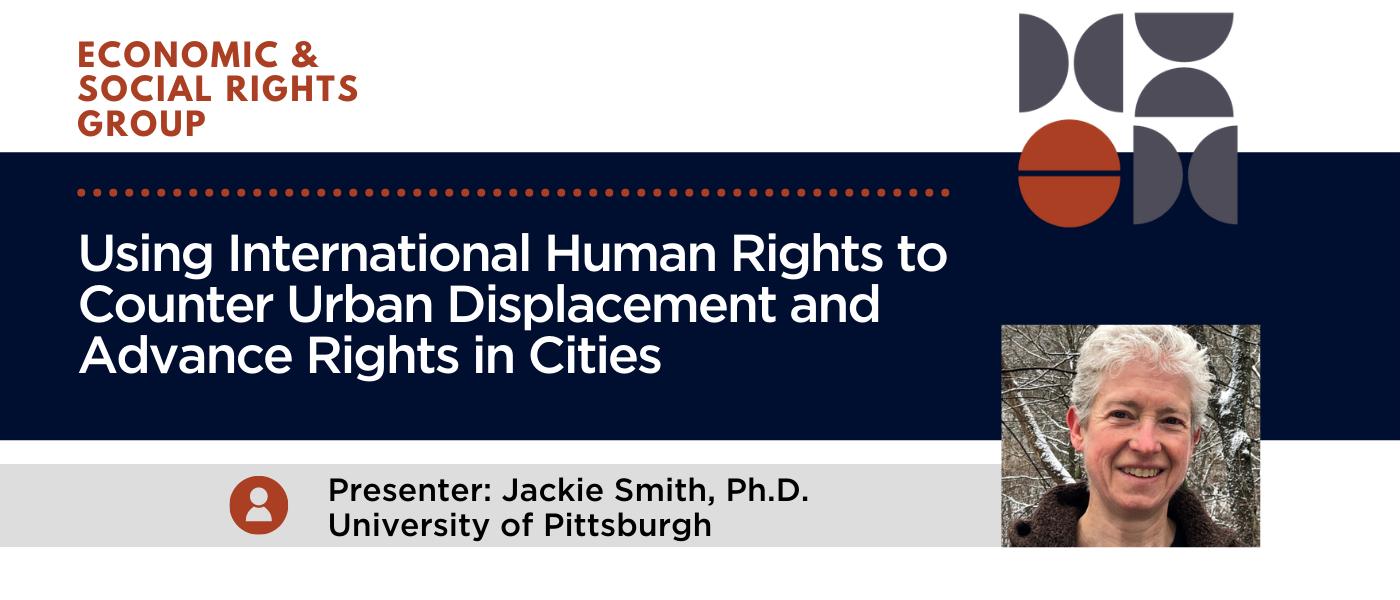
Using International Human Rights to Counter Urban Displacement and Advance Rights in Cities

Friday, March 4, 2022
12:30pm – 2:00pm
Virtual Event

About This Event:

In the second meeting of the Economic & Social Rights Group for Spring 2022, we welcome Jackie Smith, Professor of Sociology at the University of Pittsburgh.

Smith will discuss a new white paper, Pittsburgh’s Affordable Housing Crisis: Is Privatization the Solution?, which she wrote with colleagues involved in Pittsburgh’s Human Rights City Alliance. She will discuss how the project emerged from the work of a diverse alliance of human rights organizers and how it contributes to ongoing local and translocal movement-building to advance housing as a human right. It also demonstrates important roles for networks of university- and neighborhood-based activists to play in advancing human rights in cities and communities. The white paper is available to read here, courtesy of Smith and her colleagues.

Presenter:

Jackie Smith’s research focuses on how globalization impacts people and communities, and how social movements for the environment, health, and economic justice have advanced transformative struggles. She has documented long-term trends in transnational social movement organizations and coalitions, in addition to research on connections between global politics and activism in cities and communities. Smith is currently engaged in participatory research with Pittsburgh and with national human rights organizers and engaged in work to connect municipalities with United Nations human rights work.

Loader Loading...
EAD Logo Taking too long?

Reload Reload document
| Open Open in new tab

This event is virtual and will be hosted on Zoom. Click the link above to register to attend. The event will be recorded.

The Economic & Social Rights Group (ESRG) is an interdisciplinary monthly gathering of faculty and graduate students who meet to share ongoing research and to discuss current scholarship around economic and social rights. It is the central to the mission of the Research Program on Economic & Social Rights.

The Research Program on Economic & Social Rights brings more than a dozen UConn faculty together with over 30 affiliated scholars from across the United States and Canada. Together, we have generated numerous graduate and undergraduate courses, several edited volumes, multiple co-authored articles, and the National Science Foundation-funded Socio-Economic Rights Fulfillment Index (SERF Index).

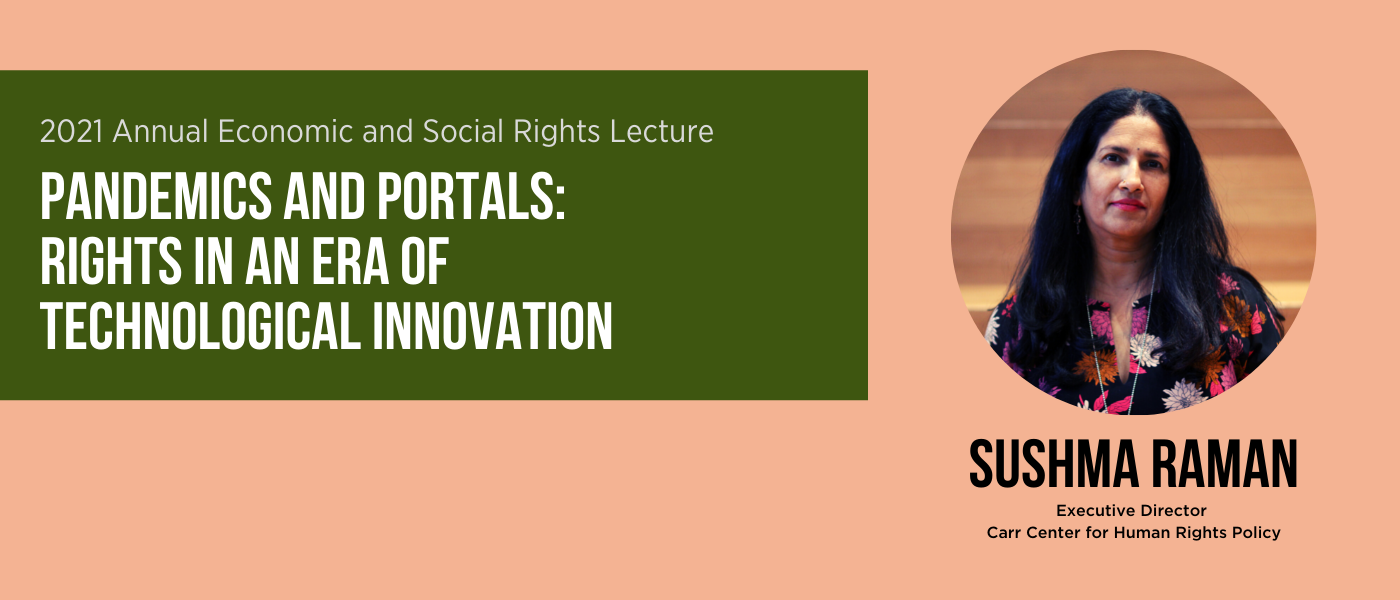
Pandemics and Portals: Rights In An Era Of Tech Innovation

Thursday, November 18, 2021
4:00pm – 5:30pm
Virtual Event

Sushma’s ESRG Lecture will draw on her co-authored book (along with Bill Schulz, former executive director of Amnesty International USA and Carr Center Senior Fellow), The Coming Good Society: Why New Realities Demand New Rights (Harvard University Press 2020). Drawing on their vast experience as human rights advocates, the authors challenge us to think hard about how rights evolve with changing circumstances. To preserve and promote the good society – one that protects its members’ dignity and fosters an environment in which people will want to live – we must at times rethink the meanings of familiar rights and consider the introduction of entirely new rights.

Sushma Raman is the executive director of the Carr Center for Human Rights Policy. She brings over two decades of global experience launching, scaling, and leading social justice and philanthropic programs and collaboratives, building capabilities of grassroots human rights organizations and their leaders, and teaching graduate courses in the public policy schools at UCLA, USC, Tufts Fletcher School, and Harvard Kennedy School. Sushma has worked at the Ford Foundation, where she helped launch and scale social justice and women’s funds around the world, and at the Open Society Foundation, where she was a Program Officer on the founding staff for US Programs on immigrant and refugee rights. She was a Fellow with the German Marshall Fund and the UCLA Luskin School, and is currently a member of the board of RFK Human Rights, established by the family of Bobby Kennedy. She has taught graduate courses on economic justice; inter-sectoral leadership; philanthropy and nonprofit management; global civil society, the NGO sector, and the state; and policy communications for decision-makers.

Sponsored by the Research Program on Economic and Social Rights at the Human Rights Institute.

Contractual Deterrence and the Ethical Supply Chain

Tuesday, November 30, 2021
1:00pm – 2:15pm
Virtual Event

Workshop on Contractual Deterrence and the Ethical Supply Chain

Presenter: Robert Bird, University of Connecticut School of Business

Discussant: Gastón de los Reyes, Glasgow Caledonian New York College

A harmful byproduct of the global economy is the proliferation of abuses in global supply chains. Too often lead firms and suppliers do not effectively collaborate. Lead firms require human rights and sustainability standards while also demanding extremely low cost goods and fast production deadlines. Suppliers faced with the impossible choice of financial survival or compliance with ethical standards, attempt to evade lead firm demands. The result is an illusion of governance that prioritizes investigations over actual changes and perpetuates “slow violence” against local environments and vulnerable populations.

To respond to this problem, this manuscript proposes a new paradigm I call ‘contractual deterrence.’ Contractual deterrence leverages a centuries-old theory of criminal deterrence, reinterprets it to incorporate a modern understanding of sanctions and rewards, and applies the theory to the contractual context of the modern global supply chain. Contractual deterrence is based upon three prongs: that enforcement of ethical supply chain standards must be predictably certain, equitably significant, and swiftly implementable. This manuscript explores these prongs and shows how the theory advances sustainability and human rights literatures. This manuscript also argues for a new multistakeholder theory of social responsibility that challenges western-dominated thinking and encourages a joint and equal partnership between lead firm and supplier in order to address pressing problems facing supply chains today.

The Business and Human Rights Workshop is dedicated to the development and discussion of works-in-progress and other non-published academic research. The paper will be distributed to registered participants prior to the Workshop. This event will not be recorded.

This event is sponsored by the Business and Human Rights Initiative, a partnership founded by Dodd Human Rights Impact, the UConn School of Business, and the Human Rights Institute.

Human Rights Day 2021

Human Rights Day | Civics Education and Democracy Today: Bringing Human Rights Close to Home

Friday, December 10, 2021
3:00–4:00pm

Join us for the virtual event.
Register Now

In recognition of this year’s International Human Rights Day – Friday, December 10, 2021 – Dodd Human Rights Impact and the Neag School of Education will host a roundtable focused on supporting the advancement of civics and human rights education in public schools.

With opening remarks from U.S. Secretary of Education Miguel Cardona, the roundtable will discuss how our students, teachers, schools, and universities can advance democracy and human rights. In particular, we’ll explore how to better foster student voice and democratic participation through civics, human rights education and school-community partnerships.

Welcome & Introduction
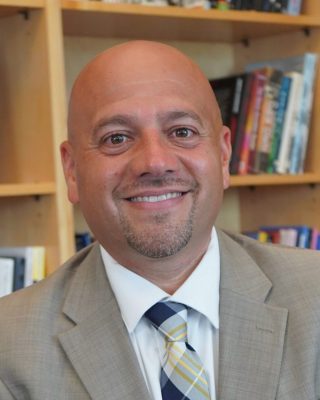
Professor Jason Irizarry
Dean, Neag School of Education

Professor Jason Irizarry

Opening Remarks
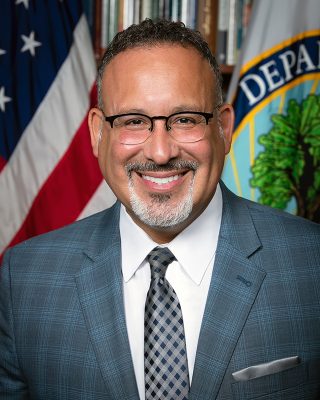
Miguel Cardona
U.S. Secretary of Education

US Secretary of Education Miguel Cardona

Roundtable Discussion Featuring
Former U.S. Senator Christopher Dodd
Assistant Professor Glenn Mitoma, Director of Dodd Human Rights Impact
Abigail Esposito, Conard High School teacher
Tyler Gleen, Teacher Education M.A. Student, Neag (’22)
Zoe Maldonado, Civic Leadership High School Student (’23)

The day’s events are also part of President Biden’s December 2021 Summit for Democracy, offering an opportunity to listen, learn, and engage with diverse voices committed to a global democratic renewal.

The roundtable is the first event of Dodd Impact’s new initiative Human Rights Close to Home – a three-year pilot program that hopes to directly engage key stakeholders, including educators and youth, in the development and implementation of a model of human rights education for civic action.

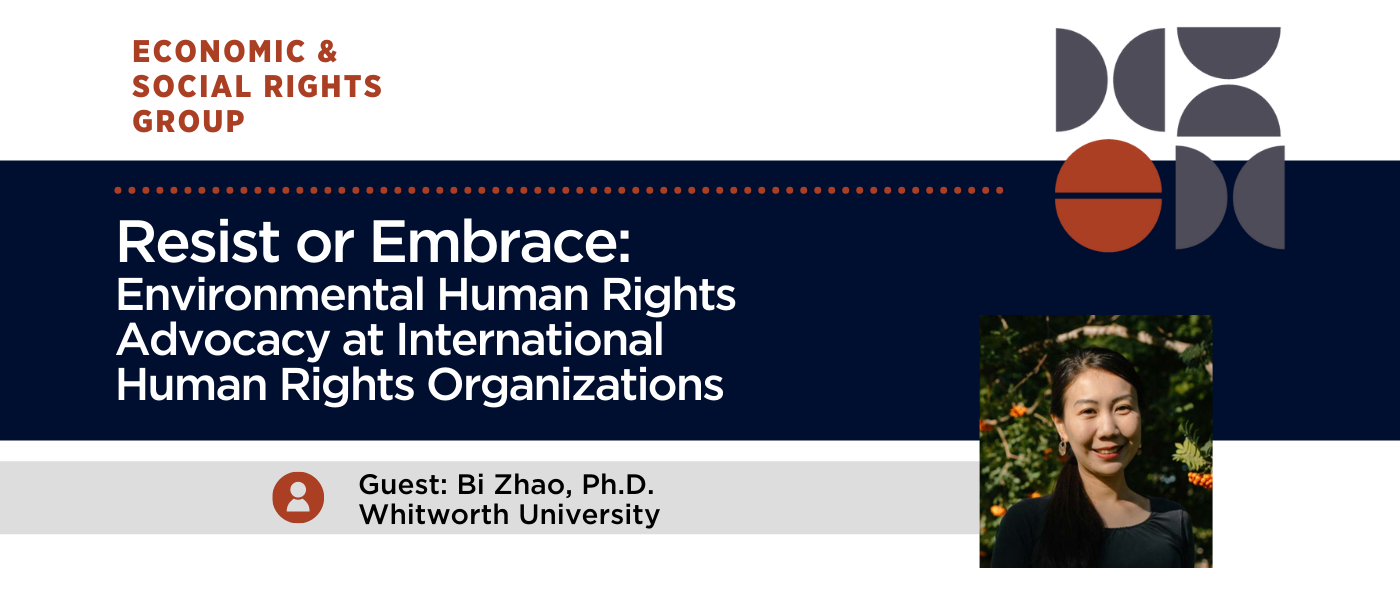
Resist or Embrace: Environmental Human Rights Advocacy at International Human Rights Organizations

Friday, February 18, 2022
12:00pm – 1:30pm
Virtual Event

Presenter:

Bi Zhao is an Assistant Professor in the Department of Political Science at Whitworth University. She specializes in international relations and methodology, with a substantive focus on democratic legitimacy in global governance, non-state actors, and international environmental politics.

About this Event:

In the first of three Economic & Social Rights Group events planned for this spring, Dr. Bi Zhao will present her research entitled “Resist or embrace: environmental human rights advocacy at international human rights organizations.”

Prakash Kashwan & Shareen Hertel (ESRG Co-Directors)

This event is virtual and will be hosted on Zoom. Click the link above to register to attend. The event will be recorded.

The Economic & Social Rights Group (ESRG) is an interdisciplinary monthly gathering of faculty and graduate students who meet to share ongoing research and to discuss current scholarship around economic and social rights. It is the central to the mission of the Research Program on Economic & Social Rights.

The Research Program on Economic & Social Rights brings more than a dozen UConn faculty together with over 30 affiliated scholars from across the United States and Canada. Together, we have generated numerous graduate and undergraduate courses, several edited volumes, multiple co-authored articles, and the National Science Foundation-funded Socio-Economic Rights Fulfillment Index (SERF Index).

Model Contract Clauses for Human Rights

Wednesday, February 9, 2022
12:30pm – 1:45pm
Virtual Event

About this Event:

A presentation and discussion of the American Bar Association’s Model Contract Clauses for Human Rights Project.

Presenters: Prof. Sarah Dadush, Rutgers Law School, Olivia Windham Stewart, & David Snyder, American University

Commentator: Prof. Erika George, University of Utah


Sarah Dadush is a Professor of Law at Rutgers Law School. Her scholarship explores innovative legal mechanisms for improving the social and environmental performance of multinational corporations. She established and directs the Law School’s Business & Human Rights Law Program and co-leads an ABA Business Law Section Working Group that has developed a comprehensive toolkit for upgrading international supply contracts to better protect workers’ human rights. Before joining the Rutgers faculty, Dadush served as Legal Counsel for the International Fund for Agricultural Development (IFAD), a specialized agency of the United Nations based in Rome. Prior to that, she was a Fellow at NYU’s Institute for International Law and Justice and an Associate Attorney at the global law firm, Allen & Overy. She received her J.D. and LL.M. in International and Comparative Law from Duke University School of Law in 2004.

Olivia Windham Stewart is an independent business and human rights specialist based in the UK, and a Senior Fellow and Deputy Director of the Business and Human Rights Law Program at the Center for Corporate Law and Governance, Rutgers Law School. As an independent specialist, Olivia has worked on a range of projects to increase corporate accountability and due diligence across sectors, including an OECD due diligence alignment assessment, a European Citizens’ Initiative for Living Wages, a range of multistakeholder initiatives in the garment and footwear industry and research, training and facilitation projects on labour rights and BHR issues for a number of organisations across sectors. Prior to working independently, Olivia was on the Labour Rights team at Laudes Foundation (formerly C&A Foundation) and at Impactt UK. She has worked extensively in production countries around the world, particularly in South and South East Asia and has been a contributing member of the Principled Purchasing Project to draft model contract clauses to protect human rights in international supply chains since March 2020. Olivia holds a MSc with Distinction from SOAS University, London.

David V. Snyder is professor of law and director of the Business Law Program at the American University Washington College of Law. His work is primarily in contracts and commercial law, including their international and comparative aspects. He has been a professor of law at Tulane and Indiana (Bloomington) and has been a regular visiting professor at the University of Paris II (Panthéon-Assas) since 2012.  He has also been a visiting professor at Boston University and William and Mary. He is a graduate of Tulane Law School and Yale College and clerked on the Fifth Circuit.

Erika George is the Samuel D. Thurman Professor of Law at the University of Utah’s S.J. Quinney College of Law and directs the Obert C. and Grace A. Tanner Humanities Center at the University of Utah. She teaches constitutional law, international human rights law, international environmental law, international business transactions, international trade and seminars on business and human rights, inequality, and corporate citizenship and sustainability. She was the Interim Director of the University’s Tanner Center for Human Rights and the University’s 2018-2019 Presidential Leadership Fellow. She is a Fellow of the American Bar Foundation and serves on the board of the American Bar Association Center for Human Rights. She earned her B.A. with honors from the University of Chicago and her J.D. from Harvard Law School, where she served as Articles Editor of the Harvard Civil Rights-Civil Liberties Law Review. She also holds an M.A. in International Relations from the University of Chicago. She is the author of Incorporating Rights: Strategies to Advance Corporate Accountability (Oxford University Press, 2021).

This event will not be recorded.

This event is sponsored by the Business and Human Rights Initiative, a partnership founded by Dodd Human Rights Impact, the UConn School of Business, and the Human Rights Institute.

Rights Beyond Words: Mapping Human Rights Scholar-Organization Partnerships

Wednesday, February 16, 2022
2:00pm – 3:30pm
Virtual Event

Presenters:

Zehra Arat is a Professor in the Department of Political Science at UConn. She studies human rights, with an emphasis on women’s rights, as well as processes of democratization, globalization, and development.

Shareen Hertel is a Professor in the Department of Political Science at UConn, jointly appointed with the Human Rights Institute. Her research focuses on changes in transnational human rights advocacy, with a focus on labor and economic rights issues.

Overview:

For this February edition of the HRI Colloquium Series, we will consider NGO-Scholar Engagement, the topic of an upcoming paper from Zehra Arat & Shareen Hertel.

Abstract:

For a sneak preview of their talk, here is the abstract of their forthcoming work: “For many human rights scholars, human rights is more than intellectual curiosity; it is the motivation for their work. They try to use their research and expertise to improve human rights conditions and work with policy makers and advocacy groups. This paper explores the complexities of partnerships between scholars and human rights organizations and groups (HROGs). Focusing primarily on the experience of social science and humanities scholars with a range of HROGs, we identify areas of tension, as well as the political implications of such engagement. The paper thus marks a critical step toward developing a more formal typology of such relationships that can be used to further explore variation in human rights outcomes stemming from such collaboration.”

This event is virtual and will be hosted on Zoom. Click the link above to register to attend. The Colloquium will be recorded.