Mission
The Business and Human Rights Initiative at UConn seeks to develop and support multidisciplinary research, education, and public engagement at the intersection of business and human rights. A partnership founded by Dodd Human Rights Impact Programs, the UConn School of Business, and the Gladstein Family Human Rights Institute, our initiative collaborates with programs and units throughout UConn.

Research
The Initiative supports and promotes scholarly research by UConn faculty in business and human rights. Reflecting the broad scope of the human rights challenges and opportunities in business, these research areas encompass:
Stakeholder Engagement
Stakeholder dialogue emerged as a formal vehicle for promoting business and human rights in the early 2000s during the mandate of the UN Secretary-General’s Special Representative John G. Ruggie. This project assesses the on-the-ground impact of such processes, at the grassroots level. Through engagement with social movements, unions and consumer advocacy networks, the project fills critical scholarly and policy gaps by producing 1) more fine-grained data on the nature of corporate social impact; 2) a fuller picture of the terms of engagement between companies and communities (both in the context of formal consultative processes and in crisis situations); and 3) more comprehensive approaches to community-informed design and implementation of remedy for harm. This project intersects with the “Corporate Accountability Mechanisms” work stream of the BHRI – specifically, through mutual exploration of evolving legal frameworks for supply chain human rights due diligence – in this case, by analyzing community members’ perspectives on such emerging laws.
Faculty and Publications
Key Faculty: Shareen Hertel
Featured Publication
Digital Human Rights
This research focuses on the responsibilities of social media platforms and the role of state regulation in regulating online speech. The research is also about the intersection of human rights and science and technology studies, considering the way in which the introduction of new technologies can undermine or strengthen the use of rights-based frameworks to achieve social change.
Faculty and Publications
Key Faculty: Molly Land
Featured Publications
- Molly K. Land and Wendy H. Wong, Human Rights, Datafication, and the Democratic Governance of AI, in Handbook on the Global Governance of Artificial Intelligence (Markus Furendal & Magnus Lundgren eds., Edward Elgar Publishing 2025).
- New Technologies for Human Rights Law and Practice
- The Meta Oversight Board’s Human Rights Future
- Hate Speech on Social Media: Content Moderation in Context
- Against Privatized Censorship: Proposals for Responsible Delegation
- Regulating Private Harms Online: Content Regulation Under Human Rights Law
- Technology and Economic and Social Rights
- Business and Human Rights Approaches to Intellectual Property
Corporate Accountability Mechanisms
Accountability mechanisms in the business and human rights field comprises judicial and non-judicial remedy processes, and domestic laws requiring human rights disclosure and, increasingly, due diligence. This research explores these mechanisms. A common theme that links the threads of research is the challenge of employing extraterritorial accountability mechanisms to address corporate misconduct, in particular from the perspective of rightsholders.
Faculty and Publications
Key Faculty: Rachel Chambers
Featured Publications
- The Political Economy of Fashion Sustainability Regulation” by Meital Peleg Mizrachi and Rachel Chambers
- Project MUSE – Human Rights Due Diligence: Views of the Process, From the Ground Up
- How European Human Rights Law Will Reshape U.S. Business
- The Securities and Exchange Commission as Human Rights Enforcer?.pdf
- Reimagining Corporate Accountability: Going Beyond Human Rights Due Diligence.pdf
- The Future of International Corporate Human Rights Litigation: A Transatlantic Comparison
- Parent Company Direct Liability for Overseas Human Rights Violations: Lessons from the U.K. Supreme Court
- Human Rights Disclosure and Due Diligence Laws: The Role of Regulatory Oversight in Ensuring Corporate Accountability
Education
Business and human rights education equips students with the knowledge and skills to create value for business and society. The Initiative supports and promotes business and human rights learning both in and outside of the classroom by:
- Assisting in the development and delivery of courses and the incorporation of business and human rights topics through the UConn curriculum, including the Social Responsibility and Impact in Business Minor and the Master of Science in Social Responsibility and Impact in Business.
- Supporting and promoting student engagement through on-campus organizations and workshops.
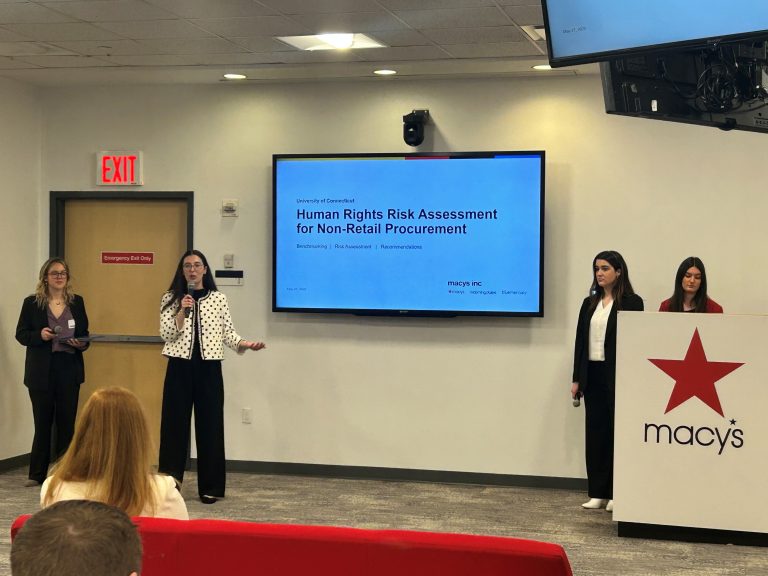
- Facilitating student internship and practicum course opportunities with corporations, civil society organizations, international organizations, and government agencies.
- Advancing business and human rights education through national and international organizations. For example, faculty member Rachel Chambers served as co-director of the Teaching Business and Human Rights Forum, an international organization dedicated to promoting and strengthening business and human rights education by fostering collaboration among teachers.

Select Course Highlights
Business and Human Rights
BLAW / HRTS / MKTG 3252/5252: This course examines the human rights implications of multinational enterprises’ global operations. Students learn how to assess corporate social impact through a human rights framework, consider the challenges of regulating the human rights impacts of global business, analyze international policy responses, and evaluate the effectiveness of different approaches to enforcing human rights standards for corporations.
Social Responsibility and Accountability in Business
BLAW/HRTS/MKTG 3254/5254: This course examines corporate social responsibility (CSR), accountability, and related concepts. Students learn about the actors, processes, legal and social norms that shape firm’s management of environmental, social and governance (ESG) issues from a global and human rights perspective. Students gain experience in identifying and critically assessing market-based solutions to societal challenges.
Sustainability, Markets, and Society
BLAW/BADM/MKTG 3253/5253: This course examines sustainability in the context of the natural and social ecosystems in which business operates. Students learn how the environmental and social impacts of business are affected by the interactions of firms with laws and legal institutions, markets, and society globally. Students gain experience assessing firm policies and practices and developing legally-astute and ethically-aware policies to achieve sustainability and to generate positive environmental and social outcomes.
Public Engagement
To advance respect for human rights, UConn faculty engage with policymakers, businesses, advocates and other stakeholders to support student learning and professional opportunities in business and human rights. Examples of our engagement include:
- Leadership and engagement with key business and human rights organizations: Teaching Business and Human Rights Forum; GBSN for Business and Human Rights Impact Community; and Global Business and Human Rights Scholars Association
- Expert Working Group membership – the United States National Action Plan on Responsible Business Conduct
- Participation in stakeholder consultations – State Obligations under the International Covenant on Economic, Social and Cultural Rights in the Context of Business Activities
United Nations Committee on Economic, Social and Cultural Rights (CESCR)
Participation in stakeholder consultations on the day of general discussion regarding State Obligations under the International Covenant on Economic, Social and Cultural Rights in the Context of Business Activities.
Our Written Contribution.pdf
CESCR News Article
Adopted General Comment No. 24
Global Network Initiative (GNI)
GNI is a multi-stakeholder group of companies, civil society organizations, investors, and academics dedicated to protecting and advancing freedom of expression and privacy in the information and communications technology sector. Molly Land, professor of law and human rights and a member of our steering committee, has served as an alternate member of GNI’s Board of Directors.
News
-

‘This is one of the experiences that makes the UConn program distinctive’
-
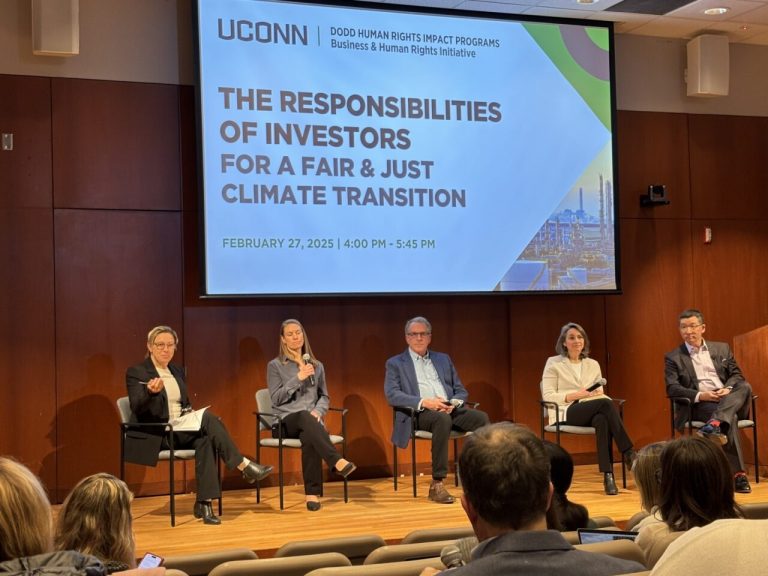
State Treasurer explored how investors can ensure no one is left behind through a just climate transition during a keynote address to UConn students and faculty
-
‘It is no longer enough to have a few well-intentioned companies or individuals to focus on corporate social responsibility’
-
‘Laura has been a champion of business in human rights not only within individual companies but also globally through her participation in policymaking at the highest levels’